One feedback loop between your brain and ovaries controls everything from ovulation to mood.
And in midlife? It starts to shift.

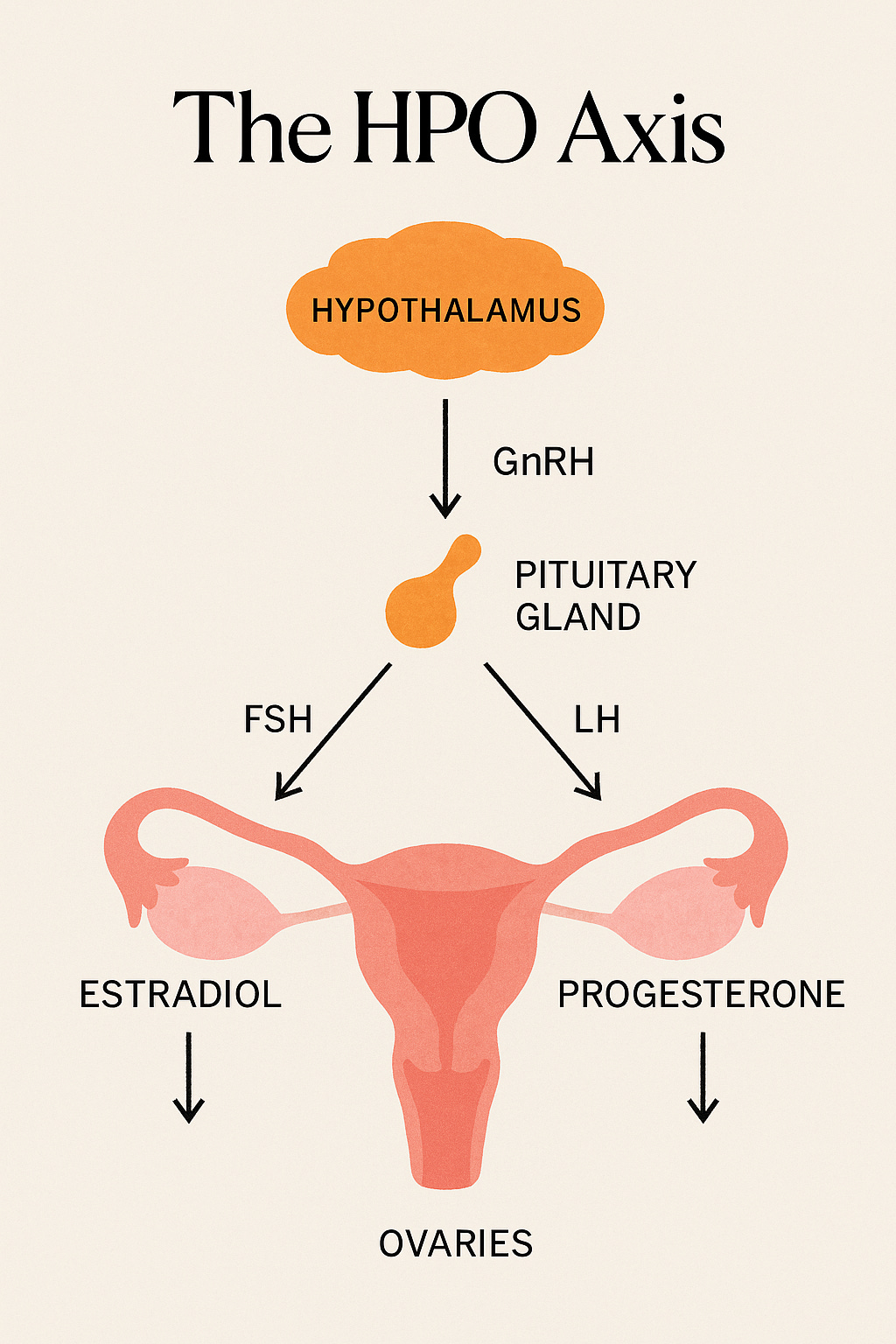
The Hypothalamic–Pituitary–Ovarian (HPO) axis is a finely tuned hormonal feedback loop between the brain and ovaries. Understanding how this system functions offers critical insight into the hormonal shifts that occur during perimenopause and postmenopause.
It begins in the hypothalamus, the brain’s master regulator of the endocrine system.The hypothalamus secretes GnRH (Gonadotropin-Releasing Hormone), which stimulates the pituitary gland to release two key reproductive hormones:
🔹 FSH (Follicle-Stimulating Hormone)
🔹 LH (Luteinising Hormone)
These gonadotropins orchestrate the menstrual cycle through a series of interdependent steps:
✔ FSH promotes the development of ovarian follicles, each containing an immature egg.
✔ The follicles with the most FSH receptors grow most efficiently. One is selected as dominant—this is the Graafian follicle.
✔ As the dominant follicle matures, it produces oestrogen, which triggers a surge in LH (and some FSH), resulting in ovulation.
✔ Following ovulation, the ruptured follicle transforms into the corpus luteum, which secretes progesterone to stabilise the uterine lining and modulate the nervous system.
During perimenopause, as oestrogen and progesterone levels begin to fluctuate and decline, the HPO axis becomes increasingly dysregulated. This contributes to a range of symptoms, including:
🔸 Irregular or skipped periods
🔸 Mood disturbances and heightened anxiety
🔸 Energy dips and cognitive fog
🔸 Sleep disruption
When you understand how your hormones are meant to work, you’re more likely to notice when something isn’t right.
That’s why I talk so much about the HPO axis. Because knowledge is powerful. Especially in midlife, when symptoms like poor sleep, anxiety, and erratic cycles can feel confusing—or even dismissed.
But here's the truth:
👉 You are the expert on your body.
👉 You do know when something feels off.
And when you understand the inner workings of your hormones, you stop feeling lost, and start feeling equipped to make decisions that support your health.
Menopause isn’t the end. It’s a shift. And the more we understand that shift, the more we can support ourselves through it—with clarity, not fear.
Ive been in your shoes and you are never alone.
Julie x